Hill-climbing MAI models for GitHub Copilot and Excel
Better models, fewer parameters, less tokens
At Build in June, we introduced our hill–climbing machine, our integrated data, model, and harness flywheel. Today we are excited to share two examples inside Microsoft: MAI models specialized for agentic workloads in GitHub Copilot and Excel.
Early results are promising. In our live product deployment, we see that our MAI model deployed in Excel is on par with GPT-5.6 for the most common tasks while being more cost-efficient.
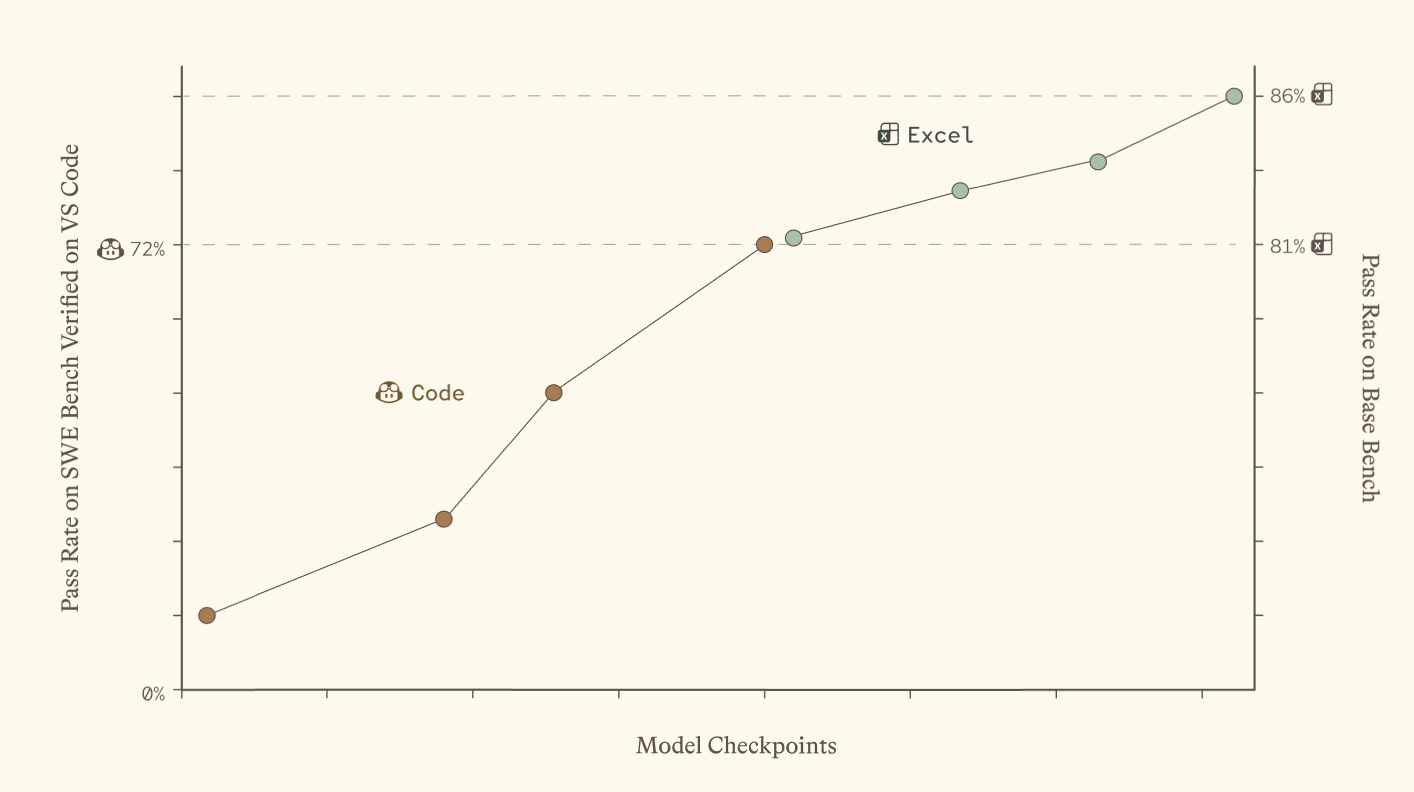
The figure below shows how MAI-Code-1-Flash, post-trained within the GitHub Copilot harness, was used as the starting checkpoint to climb on Excel evaluations, resulting in two highly efficient, specialized models.
MAI-Code-1-Flash in GitHub Copilot
Since launching MAI-Code-1-Flash in GitHub Copilot in June, millions of developers have been using it for their day-to-day work, where it’s outperforming other similarly sized models while using fewer tokens.
- It has an approximately 10% higher code accept rate than GPT 5.4 Mini and Claude Haiku 4.5 in VS Code.
- Developers were 6% more likely to return across multiple days than with GPT 5.4 Mini and 11% more likely than with Claude Haiku 4.5.
- It has 10% lower median token usage than GPT-5.4 mini and Claude Haiku 4.5, with more user-initiated turns.
MAI model live in Excel
Excel offered a test for whether the capabilities built into MAI-Code-1-Flash could transfer beyond the domain they were trained for, moving from agentic coding to agentic knowledge work. To do so, we further trained our MAI-Code-1-Flash checkpoint in an Excel reinforcement learning environment to learn about tools and knowledge workflows in spreadsheets. The result is a model with a command of Excel workflows that is more efficient and less expensive to run.
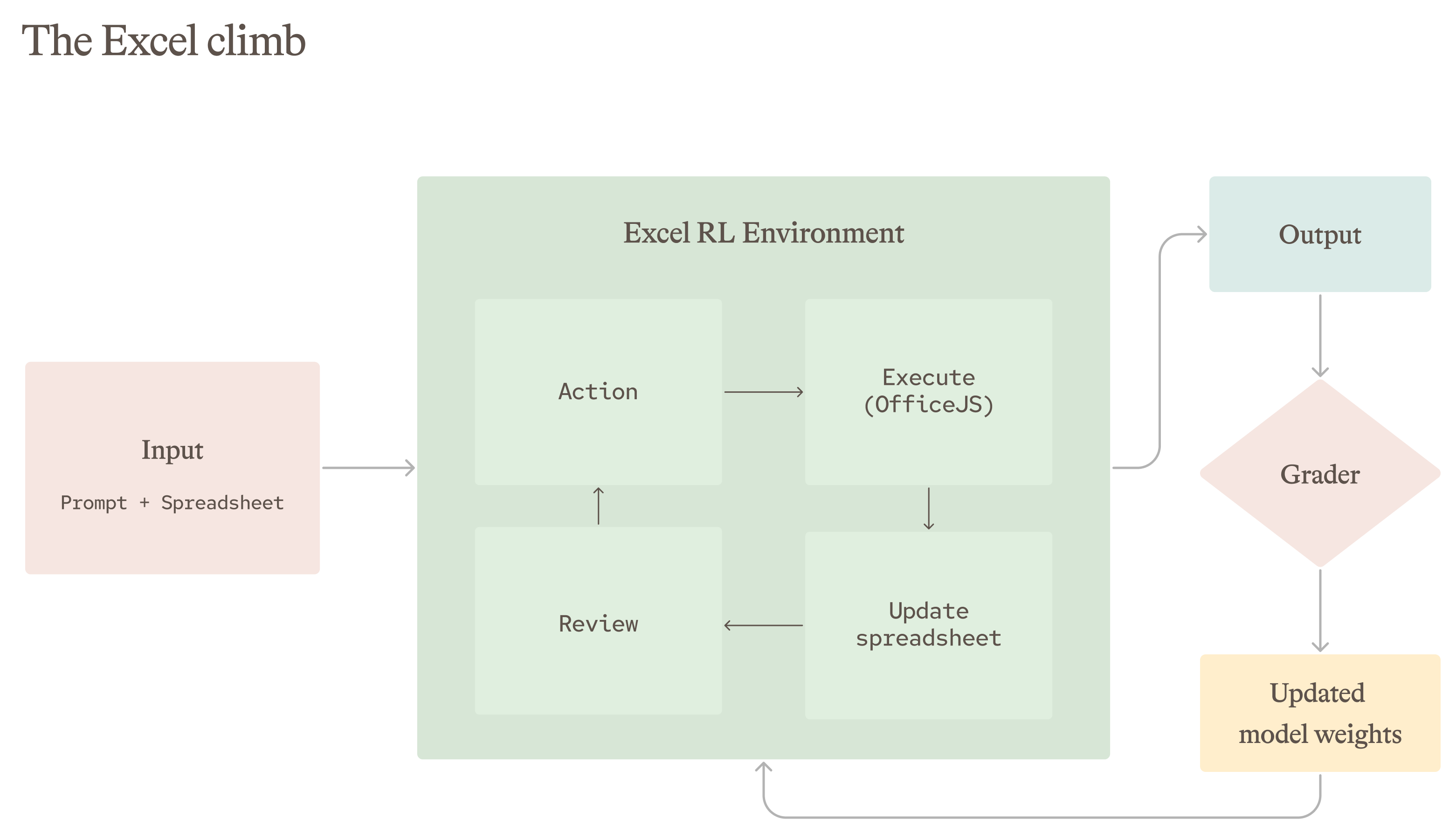
User feedback from production traffic indicates that the quality of the MAI model in Excel is on par with GPT-5.6 for the most common tasks. In addition to the direct model cost savings, this smaller, more efficient model can be served on both Nvidia H100 and A100 class GPUs rather than requiring only the latest-generation accelerators, which significantly lowers the cost of deployment for Microsoft.
Training agentic models from inside the product stack
These results point toward a broader strategy. By having access to the entire product stack—the model, the harness that runs it, the agents, and product-specific evaluations—we can hill-climb to train efficient, powerful models capable of tasks previously handled by larger, more expensive ones.
Beyond GitHub Copilot and Excel, we’re currently extending this hill-climbing approach to train efficient models across Microsoft’s family of agentic products: Copilot Chat, Outlook, PowerPoint, and more.
Learn More
- – MAI models in Microsoft products
- – Hill-climb on your own data with Frontier Tuning
- – Our hill-climbing approach