
Introducing MAI-Image-2.5-Pro and MAI-Voice-2-Flash
Superintelligence team

“MAI-Image-2.5-Pro is a strong leap forward for GenMedia tools. Beyond the impressive image quality, its ability to render text with this kind of accuracy is a real breakthrough. It also understands natural language edits, so creative iteration becomes faster and far more intuitive. Microsoft has firmly established itself among the leaders in generative AI.”
A year ago, we set out to develop purpose-built models in-house at Microsoft AI. Models trained on clean, traceable, enterprise-grade data, without distillation from third-party models, and designed from the ground up to serve the people who use Microsoft products every day.
Today, that work is showing up where it matters in the products you already rely on. The models we previewed at Build are not just topping leaderboards, they are running in production, at scale, efficiently powering experiences for millions of users across a growing portfolio of Microsoft products, including Bing, PowerPoint, OneDrive, Dynamics 365, and Azure.
Introducing two new model variants
Real-world use cases are not one-size-fits-all. A creative studio chasing maximum fidelity has very different needs from a customer service center serving millions of calls daily. That’s why we’re building families of models: to give every product the right balance of quality, speed, and cost.
Today we’re expanding those options:
- MAI-Image-2.5-Pro is now in public preview. For use cases where quality is top of mind. Hero imagery, detailed editing, precise in-image text rendering. Pro is our highest-fidelity image model to date, priced at $5 per 1M text input tokens, $8 per 1M image input tokens, and $106 per 1M image output tokens.
- MAI-Voice-2-Flash is now in public preview. First introduced at Build, Flash is built for speed and scale. It’s the fast, efficient path for high-volume voice experiences where responsiveness is everything, all while retaining the natural prosody and high acoustic quality found in MAI-Voice-2. Flash is 2x faster than MAI-Voice-2 and 32% cheaper, priced at $15 per 1M characters.
MAI-Voice-2-Flash and MAI-Image-2.5-Pro sit alongside our existing production models so builders can pick the point on the quality-speed-cost curve that fits their job.

Purpose-built models for our Microsoft products
Leaderboards are great for benchmarking the quality of our models, but the proof lies in serving users in real product use cases. Microsoft rigorously evaluates all models before deciding on the best one for use in production environments. MAI models are outperforming competitive models for quality, latency and efficiency for more of Microsoft’s product surfaces:
- Bing Image Creator is now 100% in-house by default. With MAI-Image-2.5‘s new precise image editing capabilities, it is now the default model powering Bing Image Creator end-to-end, for high-quality generation and greater creative control.
Each of these enhancements is a step toward the same goal: Microsoft products, powered by Microsoft models, built to serve the people who use them.
Built with the experts
Some of today’s most consequential and challenging fields, such as medicine or software engineering, demand more than a general-purpose model. They demand deep expertise, tight feedback loops, and models that are capable of solving complex, real-world challenges. Microsoft AI partners directly with domain specialists to adapt and refine our models for their unique needs:
- MAI is partnering with Dragon Copilot, a solution used by 170,000 medical providers, which processed 28 million patient encounters last quarter.MAI-Transcribe-1.5 now supports Dragon Copilot’s multilingual workflow, replacing the previous model with our own best-in-class model across 58 languages. In internal evaluations on multilingual recordings, the model delivers a 50% relative reduction in both transcription and language-identification error rates across most languages, and early research shows promising improvements in the downstream accuracy of medical notes.
None of this is an endpoint. It’s the compounding result of one decision: build models in-house so they can be shaped around the people who use our products, and offer options that deliver customers more choice and better value. That’s what “powered by MAI” means, model by model, product by product. We’re just getting started. In the meantime, get started with the models in Foundry. You can also learn more about MAI-Image-2.5-Pro and MAI-Voice-2-Flash on Microsoft Learn or try them out in the MAI Playground.
Build the Future With Us
We’re a lean, fast-moving lab made up of some of the world’s most talented minds. We have an exciting roadmap of compute at MAI, with our next-generation GB200 cluster now operational. And we have an ambitious mission we truly believe in. We’re also fortunate to partner with incredible product teams giving our models the chance to reach billions of users and create immense positive impact. If you’re a brilliant, highly-ambitious and low ego individual, you’ll fit right in—come and join us as we work on our next generation of models!
Related Stories


MAI Cyber 1.1 Flash:
Sharper findings and fewer tokens inside MDASH
Sharper findings and fewer tokens inside MDASH

MAI Cyber 1.1 Flash takes vulnerability discovery a step forward, delivering comparable performance to MAI Cyber 1 Flash while costing 18% less per scan on an internal MDASH vulnerability-scanning evaluation suite.
With MAI Cyber 1 Flash, we showed what’s possible when a specialized security model, Microsoft’s security data, and the MDASH harness work together.
MAI Cyber 1.1 Flash builds on that foundation. It’s a more focused model that takes on more of the work itself, so the full MDASH system can surface useful findings at lower cost.
More efficient scans
MAI Cyber 1.1 Flash is built to do more with less. On the same MDASH evaluation suite, each scan costs 18% less to complete on an internal product evaluation set.
The goal is bigger than making an individual model cheaper to run, making the entire vulnerability discovery system more efficient while preserving the performance defenders rely on.
Built on customer momentum
Customers who try MAI Cyber 1 Flash in MDASH tend to stick with it. After running their first scan with the MAI Cyber 1 Flash profile, nearly 9 in 10 subsequent scans use the MAI profile rather than the OpenAI-only model profile.
To date, MAI Cyber now accounts for almost 50% of all MDASH scans with over thousands of scans from hundreds of customers. MAI Cyber 1.1 Flash brings those customers a more focused, efficient model within the workflow they already use.
Available to MDASH customers
MAI Cyber 1.1 Flash is available through MDASH to verified customers, with safeguards in place to support responsible use, including clear usage policies and ongoing monitoring.
Try it now
- Existing MDASH customers: Select the MAI Cyber 1.1 Flash profile when starting a new scan.
- New to MDASH: Request access here.
- Learn more: Read about MAI Cyber 1 Flash inside MDASH and explore the model page.
More Stories

MAI Image 2.7 debuts above GPT Image 2.5 Flare on Artificial Analysis and #3 on Arena

MAI Image 2.7, our latest image editing model, launches with even stronger control for edits that are hardest to get right. It launches in preview at No. 3 on Arena Edit, making Microsoft AI the No. 2 lab, and No. 2 on Artificial Analysis’s image editing leaderboard.
Restyle or relight an entire scene, change text and symbols while keeping them integrated into the image, or restore and enhance existing assets. And make edits that require understanding how objects, lighting, and environments should work together.
Advancing across editing use cases
Great image editing comes down to control over the details that matter. Like moving a product into a new setting. Shifting the lighting and mood. Reworking individual objects without losing the bigger picture.
MAI-Image-2.7 improves on 2.6 across all 10 use cases and all 7 editing actions evaluated by Artificial Analysis. It reaches the category frontier in enhancement and restoration, reasoning-based edits, scene and style, and text or symbol editing. Its strongest lead is in scene and style, where it scores 24 Elo ahead of the next-best model.
For creators, that means more freedom to restyle a scene, fine-tune an asset, or bring a complex creative brief to life. It’s another step toward making powerful image editing more practical for everyday creative work.
Try it today
Try MAI Image 2.7’s image editing capabilities today on Arena, Artificial Analysis and MAI Playground. We’re starting with editing, with text-to-image generation coming soon.
Related Stories


Our first streaming transcription model debuts at no. 1 on Artificial Analysis
Along with today’s launch of our top-ranking MAI-Transcribe-2-Streaming, we’re also announcing two new voice models: MAI‑Voice‑2.1 and our blazing-fast variant, MAI‑Voice‑2.1‑Flash.
Together, they give users the fast and fluid building blocks to create conversational experiences, with no compromise on accuracy or voice quality.
Meet MAI-Transcribe-2-Streaming: Real-time transcriptions. Really fast.
MAI-Transcribe-2-Streaming delivers low-latency, real-time transcripts in 60 languages, all while supporting automatic, continuous language detection.
It ranks no. 1 for accuracy for both final and partial transcripts on Artificial Analysis. And on its accuracy-versus-latency evaluation, we sit on the Pareto frontier, showing that higher accuracy doesn’t have to come with a hefty latency tradeoff.
Rather than waiting for someone to finish speaking before returning text, it produces its first hypotheses (known as “partials”) in just over 100ms of receiving audio. It then revises them as more context rolls in and commits a stable transcript right away. These partials enable voice-enabled applications to act on speech before the speaker even finishes.
For example, voice agents can start reasoning or calling tools mid-sentence, and live transcripts can appear as people talk. For use cases such as real-time dictation or subtitling, our internal evaluations show that words appear in the transcript 2x faster than with our closest competitor.
MAI-Transcribe-2-Streaming is available at an introductory price of $0.54 per hour of audio through the end of the year.
MAI-Voice-2.1: Seamlessly support multilingual experiences
With the launch of MAI-Voice-2.1, we offer our strongest multilingual text-to-speech model yet.
We’ve expanded the model to support 23 languages and 26 locales, while enabling one single “voice” to use all languages with a truly native accent. Just ask it to speak English… then Mandarin… then German… and the speaker stays unmistakably the same, naturally picking up the local parlance, rather than dragging one accent across languages.
That means your brand can keep a single voice everywhere: a tutoring app can switch languages mid‑lesson without swapping teachers, and a multilingual assistant can reply in whatever language it’s addressed in, all while still sounding like the same voice.
And it’s priced at $22 per 1M characters.
MAI-Voice-2.1-Flash: Built for volume
MAI-Voice-2.1-Flash supports the same languages, and cross-language speakers, as MAI-Voice-2.1. But it’s been leveled up for high-volume, latency-sensitive workloads. It can generate 45s of audio, with an end-to-end latency, of a mere 150ms.
It delivers 55% faster model inference and is ~60% cheaper than comparable models, with best-in-class pricing of $15 per 1M characters.
That combination of latency, quality, and cost efficiency makes Flash a natural partner for MAI-Transcribe-2-Streaming when building natural, low-latency voice agent experiences.
Both voice models support cloning across all supported languages, using just a few seconds of reference audio, making it easier for customers to use their brands’ voices. At the same time, they have built-in consent guardrails that prevent misuse.
Closing the loop
A voice agent is a loop. It has to hear, understand, decide, and speak. And do it all within the window where a human still experiences the interaction as a conversation. Every component either buys you time in that window… or spends it.
Pairing MAI-Transcribe-2-Streaming with MAI-Voice-2.1-Flash buys time back on both ends. The time saved gives your agent more room to reason, use tools, and check its answer. All while keeping the conversation moving at a human, conversational speed.
Voice agents powered by MAI, put to work
The applications keep expanding, but developers can build these today:
- Customer service agents that transcribe requests as they’re spoken, begin acting before the caller finishes, and respond in natural speech
- Multilingual assistants that automatically detect the spoken language and reply in any of the 23 supported MAI-Voice languages, in the same voice and with a native accent
- Interactive learning and media that use distinct speakers for tutoring, role-play, simulations, narration, and conversational content across every supported language
Start building now
To show these models working together in a live agent, we built Chatter, a new demo in the MAI Playground.
You can get to work with MAI-Voice-2.1 and MAI-Voice-2.1-Flash through OpenRouter, and all three models through:
- Microsoft Foundry
- MAI Playground
- Vercel
- LiveKit (coming soon)
- Azure Voice Live
Build the Future With Us
We’re a lean, fast-moving lab made up of some of the world’s most talented minds. We have an exciting roadmap of compute at MAI, which is ramping quickly and extensively. And we have an ambitious mission we truly believe in. We’re also fortunate to partner with incredible product teams giving our models the chance to reach billions of users and create immense positive impact. If you’re a brilliant, highly-ambitious and low ego individual, you’ll fit right in—come and join us as we work on our next generation of models!
More Stories

Pushing the quality-cost frontier with MAI-Image-2.6

MAI-Image-2.6 is our strongest image model yet. Today, we’re bringing it to developers in Microsoft Foundry and expanding the family with MAI-Image-2.6-Flash – built to deliver that same level of quality for latency-sensitive, high-throughput production workloads.
Both models come with support for multi-image reference editing, web grounding, and dynamic aspect ratios. Developers now have choice between maximum precision with MAI-Image-2.6 and production speed with MAI-Image-2.6-Flash.
Quality at production speed
MAI-Image-2.6 has established itself among the industry’s leading image models. Today, it ranks No. 2 for both text to image and image editing on Arena.[1] On Artificial Analysis, it ranks No. 2 for text-to-image and No. 1 for image editing.[2]
MAI-Image-2.6-Flash brings comparable quality to latency-sensitive, high-throughput workloads. It is able to generate images 2.8x faster than GPT-Image-2-Medium while delivering 72% greater efficiency.
Leading quality for the price
MAI-Image-2.6’s combination of quality and efficiency delivers the best price-per-Elo performance in the world, helping production teams scale high-quality image generation while keeping token usage and costs under control.
More ways to create
We’ve been listening closely to how users create with our image models and have expanded their capabilities around the creative workflows that matter most.
The latest models offer more control, more context, and more ways to bring ideas to life:
- Multi-reference editing brings together people, products, styles, and scenes from different images
- Web grounding pulls info from across the web to create rich visuals informed by relevant, up-to-date information
- Higher resolutions and dynamic aspect ratios chooses the optimal format for compositions with support for up to 1.5K resolution.
Start Creating
Try both models in MAI Playground, or start building in Public Preview through Microsoft Foundry.
FOOTNOTE:
[1] As of Sep 4, 2026
[2] As of Sep 4, 2026
Build the Future With Us
We’re a lean, fast-moving lab made up of some of the world’s most talented minds. We have an exciting roadmap of compute at MAI, which is ramping quickly and extensively. And we have an ambitious mission we truly believe in. We’re also fortunate to partner with incredible product teams giving our models the chance to reach billions of users and create immense positive impact. If you’re a brilliant, highly-ambitious and low ego individual, you’ll fit right in—come and join us as we work on our next generation of models!
Related Stories

MAI-Transcribe-2 is the fastest, most accurate and cheapest speech recognition model in the world

Introducing MAI‑Transcribe‑2. It’s not only our most capable transcription model yet, but the most capable and efficient amongst our competitors.
With new features like diarization, configurable transcription styles, and word-level timestamps, MAI-Transcribe-2 beats other leading models like Gemini 3.5 Transcribe, GPT-Transcribe, Whisper V3-Large, and ScribeV2, while also handling a broader range of real‑world audio.
Our model ranks first on the FLEURS benchmark across 60 languages with an average Word-Error-Rate of 5.2%, defines the Pareto Frontier for accuracy and latency on Artificial Analysis, and ranks second on the Artificial Analysis Word-Error-Rate leaderboard, continuing the hill-climbing from previous versions.
Solve more challenges with a single model
From clinical note-taking to legal documentation, and from accessibility to closed captioning, MAI-Transcribe-2 is designed to take on real-world applications, with:
- Faster inference with substantially lower latency, especially for long‑form audio, with up to 10× faster processing than leading competitors.
- Speaker diarization distinguishes between speakers and attributes words to the right person within a recording
- Word‑level timestamps provide precise timing for every word, enabling more accurate alignment, search, navigation, and editing
- Keyword biasing helps the model recognize domain-specific terminology, abbreviations, names, and other terms that can be difficult to distinguish from context alone
- Configurable transcription styles give developers control over the output. The “verbatim” setting captures speech as spoken, including filler words and false starts, for compliance and analysis workloads. The “clean” setting removes fillers to produce more readable captions, notes, and published transcripts
- Code switching supports conversations that naturally move between languages, including commonly blended language pairs such as Hinglish and Spanglish
- Automatic language identification accurately detects the specific language being spoken without users needing to specify in advance
- Robust performance in noisy conditions helps maintain transcription quality beyond controlled recording environments
- Accurate across 60 languages to provide quality transcription for developers around the world
Efficiency without sacrificing accuracy
MAI‑Transcribe‑2 is incredibly efficient, leading the Artificial Analysis accuracy-latency Pareto frontier, combining leading transcription quality with market‑leading batch speed. It’s significantly faster than the latest models from major competitors, delivering a clear advantage when low‑latency transcription is critical.
Based on evals run by Artificial Analysis, the model is 10x faster than OpenAI’s GPT‑Transcribe, 7x faster than ElevenLabs’ Scribe v2, and 5x faster than Gemini 3.5 Transcribe while delivering higher accuracy.
Consistent quality across 60 languages
MAI‑Transcribe‑2 is accurate across more languages than any other model.
Our evaluations on the public, multilingual benchmark FLEURS show that it maintains a consistently high accuracy bar across all tested. Developers needing to transcribe across multiple languages can choose one single model, reducing complexity and even potentially saving GPU utilization issues.
High performance at the best price
Highly efficient means highly cost-effective. MAI-Transcribe-2’s speed and throughput allow us to offer the most competitive price in the market, helping developers process more audio without compromising transcription quality. At launch, MAI-Transcribe-2 will be priced at $0.10 per hour as a limited-time offer until the end of the year.
Try MAI-Transcribe-2 today
MAI-Transcribe-2’s powerful capabilities are available to demo today, through Microsoft Foundry, MAI Playground and Open Router.
Build the Future With Us
We’re a lean, fast-moving lab made up of some of the world’s most talented minds. We have an exciting roadmap of compute at MAI, which is ramping quickly and extensively. And we have an ambitious mission we truly believe in. We’re also fortunate to partner with incredible product teams giving our models the chance to reach billions of users and create immense positive impact. If you’re a brilliant, highly-ambitious and low ego individual, you’ll fit right in—come and join us as we work on our next generation of models!
Related Stories
MAI Image 2.6 launches at No. 2 on Arena ahead of Google, Meta and xAI
Updated as of October 27th, 2026
MAI Image 2.6 and MAI Image 2.6 Flash are now generally available in Microsoft Foundry. Learn more about the launch here.
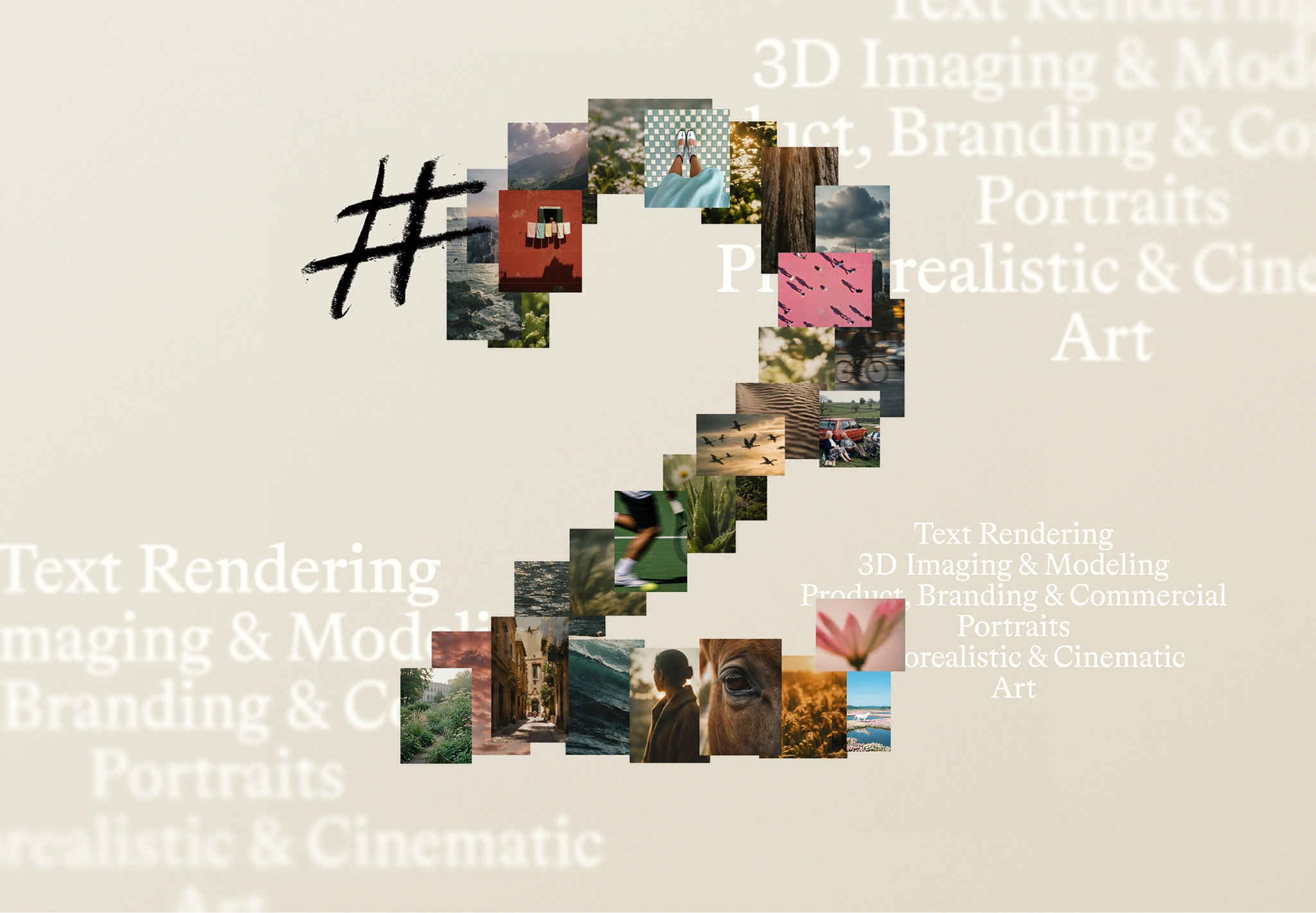
Today, we’re announcing MAI Image 2.6 – ranked second on the Arena text-to-image leaderboard.
It’s another significant climb for the MAI Image family, improving +79 Elo over MAI Image 2.5 overall, with gains across every Arena text-to-image category. Text rendering alone improves by +91 Elo.
This result firmly establishes MAI Image ahead of leading models from Meta, Google and xAI.
Another step up in quality
With every MAI Image release, we’re focused on moving the quality frontier forward.
MAI Image 1 gave us the foundation. MAI Image 2 made a major jump in photorealism, text and creative range. MAI Image 2.5 pushed further into professional-grade imagery and editing.
MAI Image 2.6 continues that climb with broad gains across different categories that we know our users care about most:
- Stronger text rendering
- Better portraits and 3D imagery
- More polished commercial and photorealistic outputs, with stronger results across product, branding and cinematic use cases
In the Arena evaluations, MAI Image 2.6 significantly improves on 2.5 in every measured category.
And there’s more to 2.6 – from working across multiple references and richer grounding to greater control over reasoning, format and resolution. We’ll share more on that soon.
More to come
MAI Image 2.6 is another step in building our hill-climbing machine for image generation: continuously improving quality, expanding capability, and turning those gains into models that are more useful for real creative work.
Try MAI Image 2.6 for text-to-image today on Arena. Coming later this week to MAI Playground, and rolling out soon across Microsoft Foundry and other products.
Build the Future With Us
We’re a lean, talent-dense team of explorers, researchers, and full-stack engineers. We move fast, sweat the details, and operate at frontier scale with a roadmap to build the world’s most powerful AI models. Most importantly, we’re united by the belief that doing this right is the only way to do it at all. If our mission resonates with you, we’d love to talk.
Related Stories
MAI-Code-1.1-Flash:
Better, faster, at a quarter of the cost
Better, faster, at a quarter of the cost
Updated as of: October 7th, 2026
- Bringing MAI-Code-1.1-Flash to on-device hardware: Optimized using 3-bit quantization, it reduces memory requirements while retaining a full 256K context window and comparable coding performance to its full-precision counterpart on SWE-Bench Verified and Terminal-Bench 2.1.
- On-device coding, with zero inference charges for local model calls. MAI-Code-1.1-Flash gives Copilot’s router an on-device option, enabling eligible coding work to run on your hardware while complementing cloud models for tasks that need more capability.
- MAI-Code-1.1-Flash is available to download and run locally. For best performance, we recommend devices with more than 120GB of RAM.
- Experimental access will be available in GitHub Copilot across the GitHub Copilot app, GitHub Copilot CLI, and Visual Studio Code by end of the month.

MAI-Code-1.1-Flash produces higher quality code, at 25% greater token efficiency, and at a quarter of the cost compared to the model we launched in June at Microsoft Build. This small, efficient, coding workhorse is now in production in GitHub Copilot.
We learned from developer feedback that CLI tasks and .NET performance mattered, so that’s where we focused. The result: a 22% improvement on Terminal-Bench 2.1 in GitHub Copilot CLI and a 15% improvement on .NET tasks.
Benchmarks are useful guides but production is where the rubber meets the road. Most importantly, code survival rose 4% and return visits increased 9%.
1.1 is also dramatically more efficient. In GitHub Copilot tokens stream 25% faster and the model uses 25% fewer tokens to complete a task. That means faster answers, less waiting, and more useful work from every token—not simply a bigger model with a bigger bill.
Better training and serving efficiency let us offer a stronger, faster model at one quarter of the price of 1.0—and pass those savings reliably to customers. We achieved this by optimizing for real-world use across more than hundreds of thousands of reinforcement-learning environments in GitHub Copilot.
The loop is simple: ship, learn, improve, repeat. That’s the MAI hill climbing machine.
Help shape future improvements
Try MAI-Code-1.1-Flash today in GitHub Copilot, then tell us what needs improving by opening an issue here.
Build the Future With Us
We’re a lean, talent-dense team of explorers, researchers, and full-stack engineers. We move fast, sweat the details, and operate at frontier scale with a roadmap to build the world’s most powerful AI models. Most importantly, we’re united by the belief that doing this right is the only way to do it at all. If our mission resonates with you, we’d love to talk.
Related Stories
Optimizing the frontier
performance curve
Mustafa Suleyman
performance curve
Tokenmaxxing has been the story of the last few months, but token efficiency is the next big focus across the industry. How do we get the best possible performance per token invested, and the best real customer outcome per dollar invested?
To build a frontier firm, you have to optimize frontier performance against cost. Choosing where you want to sit on that curve is critical. By co-optimizing your models, harnesses, and RLEs you can pick a point on the curve that suits your firm.
In most cases, frontier generalist models aren’t necessary for every task. By tuning models for a specific product, you can maintain or even exceed frontier performance, while reducing token costs dramatically.
This is where we have focused our MAI hill-climbing machine over the last quarter, and the results are pretty cool. This week we released MAI-Cyber-1-Flash optimized for our MDASH harness.
Together, the system delivers 96% on CyberGym (on the benchmark’s any crash score; outperforms Mythos on the CyberGym leaderboard) at 50% of the cost when compared against our best offering in MDASH today. And remarkably, we serve it on H100s too.
It was designed to handle up to 90% of tasks efficiently, so that MDASH can reserve the largest and most expensive models in our fleet (in this case GPT 5.4) for the 10% of exceptionally hard problems that truly need them.
As Satya mentioned today in our Q4 Earnings call, since last quarter, we’ve shipped more than a dozen new models across image, voice, transcription, coding and security, and they’re already powering many of Microsoft’s most widely used products to maintain or improve quality while using significantly fewer tokens, in many cases saving 50-90% of GPU costs:
- We built MAI-Code-1-Flash hand-in-hand with our colleagues at GitHub, where since June millions of developers have used it in their daily work. 10% higher code accept rate and 10% lower median token usage than GPT-5.4 Mini and Claude Haiku 4.5 in VS Code, and already showing improved retention.
- We then trained that same checkpoint inside an Excel RL environment to achieve comparable performance to GPT-5.6 for the most common tasks while being more cost-efficient, and small enough to serve on an A100 or H100 vs only the latest and most expensive accelerators.
- MAI-Image-2.5-Flash, is now the end-to-end default in Bing Image Creator, in production in PowerPoint where it is reducing GPU costs up to 84% compared with GPT-Image-2, and is the default for key OneDrive editing scenarios, where it has increased save rates by 26% and delivers up to 2.5x greater token efficiency.
- MAI-Voice-2-Flash now powers Dynamics 365 Contact Center, where customers like T-Mobile and EasyJet build their call center agents, reducing GPU costs by up to 89%.
- MAI-Transcribe-1.5 now serves Dragon Copilot’s multilingual workflow across 58 languages — a solution used by 170,000 medical providers that processed 28 million patient encounters last quarter, where our tests show a 50% relative in reduction transcription and language-identification error rates.
And what’s more, by co-designing our models with our own silicon, we are seeing 40% better performance per watt running MAI models on Maia 200.
But the benefit is not only cost. It’s resilience. Every business now must assume that any one model it depends on could disappear, through a security incident, a business or policy misalignment, or a geopolitical shift.
Every model in a product or agentic system should be substitutable, and that’s only possible when you build the harness, context, memory and action space independently of a single model family. That’s the hill-climbing machine we’ve built.
We think this is the beginning of a genuinely new performance curve. Its shape represents a system rather than a model, and traversing this curve delivers better quality, lower cost, and more choice.
This has been a summer of hard but wonderful work by the team. We are keenly aware of how early this is, and of how much we still have to learn. But the direction is clear, we are hill-climbing to move the frontier on the cost-to-outcome curve, and we will keep sharing what we learn along the way. There is much more to come.
Build the Future With Us
We’re a lean, talent-dense team of explorers, researchers, and full-stack engineers. We move fast, sweat the details, and operate at frontier scale with a roadmap to build the world’s most powerful AI models. Most importantly, we’re united by the belief that doing this right is the only way to do it at all. If our mission resonates with you, we’d love to talk.
Related Stories
Introducing MAI-Cyber-1-Flash inside MDASH
& Hayete Gallot

Today we’re announcing MAI-Cyber-1-Flash inside of MDASH, our multi-agent vulnerability identification and remediation harness. Together they deliver world-class performance at 50% of the cost of leading models.
Progress in AI has been startling and so has the new generation of cyber threats it’s unleashing. Attackers now wield increasingly powerful capabilities, probing an ever-growing mountain of code for just a single weakness that lets them in.
As the cost of finding a flaw collapses, the old model of security, where you scan occasionally and patch eventually, is now obsolete. If we’re to unlock the true benefits of AI, we must first build outstanding cyber models that help all of us harden the software the world runs on.
That’s the motivation behind MAI-Cyber-1-Flash, which has been built to find challenging vulnerabilities in complex codebases. It’s been deeply integrated into MDASH, honed by the best cybersecurity experts in the industry and hardened across the largest security estate on the planet.
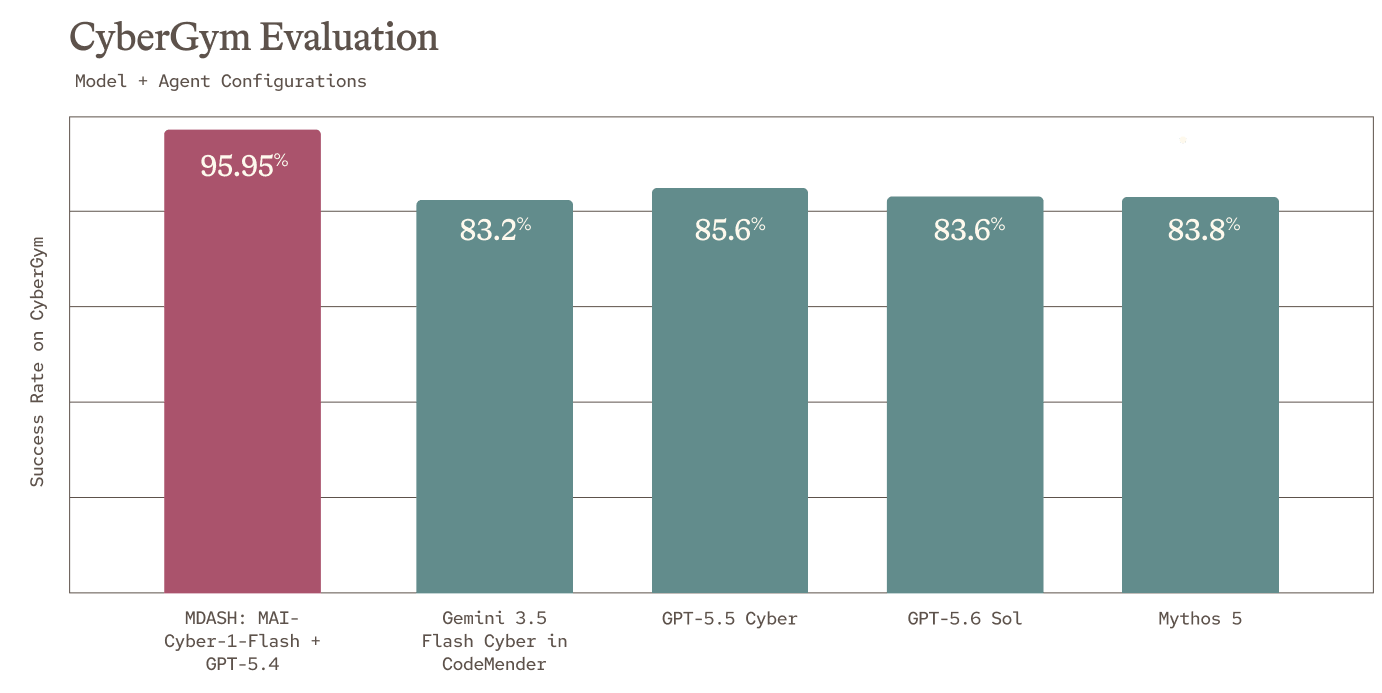
This combined expertise delivers exceptional security protection, beating Mythos, Gemini and GPT on CyberGym, the gold standard benchmark for evaluating how systems reason over large codebases to find real vulnerabilities in the code.
Picking the right model for the task
Security is an always-on mission, and given the enormous volume of inbound attacks, token cost is now the real constraint for defenders. MAI-Cyber-1-Flash was designed to efficiently handle up to 90% of all tasks, enabling MDASH to use the larger and most costly models in our fleet (in this case GPT-5.4) for the 10% of exceptionally hard tasks that truly need them.
The result is that the unified system of MDASH with MAI-Cyber-1-Flash delivers 96% on CyberGym (on the benchmark’s any crash score; outperforms Mythos on the CyberGym leaderboard).
This combination delivers a 50% cost saving when compared against our best offering in MDASH today (GPT 5.4 + 5.4 mini + 5.3 codex). That’s the power of a well-tuned, multi-model system with access to uniquely rich historical training data. It ensures you always have the best model at the best price for every task.
In this new environment, being able to go from identifying a new vulnerability to addressing it in real-time is critical. And while AI remediation of software vulnerabilities is now a key security workflow, there are many jobs to be done by Security practitioners themselves.
That’s why today we’re also launching Perception, our agentic security systems, that provides teams of agents for a variety of security workflows in MDASH, to continuously monitor, patch, and close new threat vectors. Perception will also soon use MAI-Cyber-1-Flash for many more security workflows, beyond the software vulnerability work.
Three things matter today: Model. Data. Harness.
We have jointly optimized our world-class models, our unmatched historic data, and our expert-tuned harness to ensure that our customers have a uniquely powerful security offering.
Model. MAI-Cyber-1-Flash is a compact, code-heavy security model derived from the MAI-Thinking-1 lineage, which was built from scratch, in-house, on the highest quality data. Details in our technical report.
Data. Our deepest advantage. Decades of building world-class security systems now give us trillions of daily signals across identity, endpoint, cloud, and network, and an unmatched record of real exploits and remediations. No one can manufacture this history.
Harness. MDASH, our multi-agent vulnerability identification and remediation harness, is tuned by the best security experts in the industry, who have created 100+ agents using multiple leading models to find, validate, and remediate vulnerabilities. Agentic code scanning is a critical function in the Security Operating Center and feeds Project Perception, our new agentic security system.
Built with safety first
Because MAI-Cyber-1-Flash is Microsoft’s first cyber model, we built trust into every layer of the system, from model training to customer deployment. The model was developed with a security-first calibration, rigorously evaluated by Microsoft’s AI Red Team, tested through automated and expert-led adversarial exercises, and independently assessed by a third party.
Trust extends beyond the model itself. Through MDASH, customers get enterprise-grade controls including Role-Based Controls, tenant isolation, encryption, auditability, and sandboxed execution environments with no internet access. The result is a cyber model that delivers powerful capabilities to defenders while maintaining the governance, security, and control enterprises expect from Microsoft.
Our hill-climbing machine
Cybersecurity is not just a data-rich domain; it is a live reinforcement learning loop. Every day, defenders investigate threats, triage alerts, hunt adversaries, remediate vulnerabilities, deploy protections, and learn from the outcome.
Microsoft sees that loop end to end: vulnerabilities through Microsoft Security Response Center; attacks and defenses across identity, endpoint, cloud, data, browser, and applications; more than 100 trillion security signals every day; and operational insight from 1.6 million customers. Because we can connect actions to outcomes; what was exploitable, what was contained, what was blocked, and what actually worked; we have more than data.
Our MAI reinforcement learning loop gives us the foundation to build cyber models that improve continuously and become expert cyber defenders. That’ll remain our commitment to our customers for years to come.
Updated as of August 13th, 2026
Clarification on CyberGym scores
- Any-crash: measures the ability of the agent to identify vulnerabilities that can crash the code under evaluation with an input that triggers any existing or 0-day vulnerability. Our 96% score is an any-crash score
- Target (Any-of): measures the ability of the agent to generate one or more candidate vulnerability triggering inputs with at least one of the candidates mapping to a known vulnerability in the CyberGym test suite. On this measure, our score is 90.4%
- Final-submission: new scoring mechanism introduced in July. Builds on the any-of method and asks the agent to pick only one vulnerability triggering input which is compared to the known vulnerabilities in the CyberGym test suite. Our scores take a conservative approach and filter out edge cases that may be interpreted incorrectly as valid crashes by the Cybergym evaluator. The 86.3% number on the CyberGym leaderboard is a final-submission score
Build the Future With Us
We’re a lean, talent-dense team of explorers, researchers, and full-stack engineers. We move fast, sweat the details, and operate at frontier scale with a roadmap to build the world’s most powerful AI models. Most importantly, we’re united by the belief that doing this right is the only way to do it at all. If our mission resonates with you, we’d love to talk.